MYaccess Research Observation Series
WHO Guidance Review – Peripheral Intravenous Catheters (PIVC)
Preliminary analysis of WHO framework, published literature, and observational data (n≈36)

Overview
Peripheral vascular access remains one of the most performed invasive procedures in modern healthcare. Despite this, the technique continues to rely primarily on palpation and visual estimation.
This analysis reviews WHO guidelines, published evidence, and real-world observations (n≈36) to determine whether current practice reflects an optimized system—or an incomplete one.
Document Analyzed
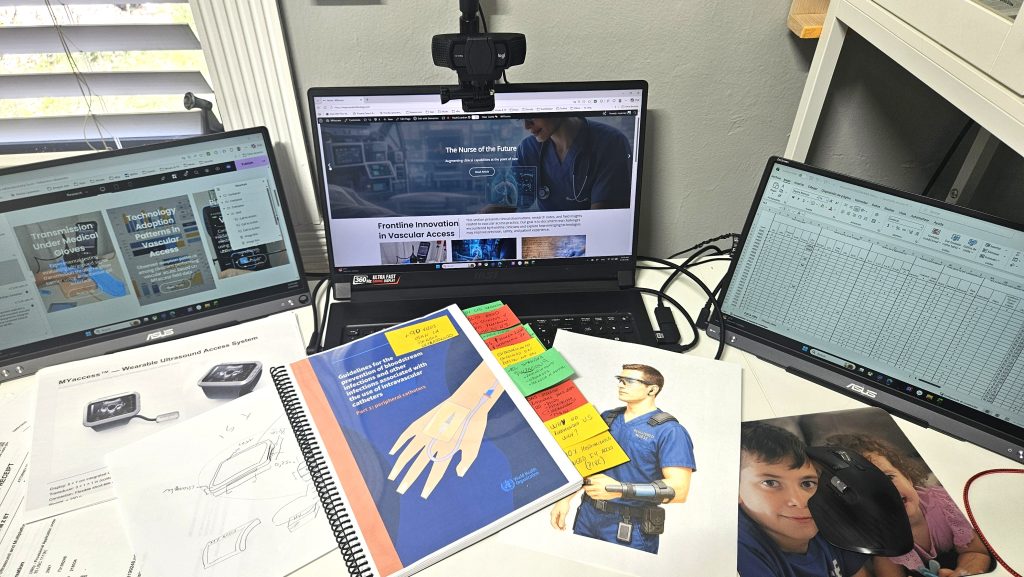
This analysis is based on the World Health Organization (WHO) document:
“Guidelines for the Prevention of Bloodstream Infections and Management of Peripheral Intravenous Catheters (PIVC)”
Key Observation
The WHO document does not present peripheral IV access as a fully optimized procedure. Instead, it directly compares routine palpation-based insertion with ultrasound-guided techniques and evaluates outcomes such as success rate, number of attempts, and complications.
This suggests that variability, failed attempts, and procedural inefficiency are already recognized at the highest levels of clinical guideline development.
In our internal review of the document, the term “ultrasound” appears more than 90 times, indicating that it is not a secondary concept, but a central element in the discussion of improving vascular access outcomes.
Current vascular access workflow remains dependent on external devices, delayed access to imaging, and operator-dependent technique. This creates variability in performance, repeated attempts, and inefficiencies at the point of care.
Even when advanced tools such as ultrasound are available, they are often not integrated into the clinician’s immediate workflow, requiring additional steps, equipment, and positioning that limit routine use.
This gap between available capability and real-world execution represents a key limitation in current vascular access practice.
What Clinical Evidence Shows
Published literature consistently shows that peripheral IV access is not as reliable as often assumed. First-attempt failure rates can reach up to 40% in adult patients, with even higher rates reported in certain populations.
Repeated attempts are associated with:
- Increased patient pain
- Delayed treatment
- Vascular damage
This reinforces that current practice, while widely used, remains inconsistent in performance.
The Contrast: When Ultrasound Is Used
When ultrasound guidance is used, clinical performance improves significantly. Studies have shown higher success rates, fewer attempts, and better outcomes, particularly in patients with difficult intravenous access.
This creates a clear contrast:
While traditional palpation-based techniques show high variability and failure rates, ultrasound-guided access demonstrates that more reliable performance is achievable.
The limitation is not the absence of a better method.
The limitation is the lack of consistent integration into routine clinical workflow.
Observational Data (n≈36)
Preliminary observations from frontline clinical users (n≈36) indicate that current vascular access practice remains heavily dependent on palpation-based techniques.
Across participants, approximately 85% relied primarily on palpation, with minimal routine use of ultrasound guidance, even in environments where the technology was available.
Additionally, workflow-based testing demonstrated that integrating technology at the hand level did not significantly interfere with the execution of critical procedures, suggesting that ergonomic integration is feasible within real clinical conditions.
These findings reinforce that the primary limitation is not clinical knowledge or available technology, but the lack of seamless integration into everyday practice.
Conclusion + Origin of MYaccess™
The convergence of global guidelines, clinical evidence, and real-world observations leads to a clear conclusion:
Peripheral IV access is not a solved problem. It is a system with known limitations, measurable inefficiencies, and inconsistent performance.
The evidence shows that improved methods already exist. Ultrasound-guided access demonstrates higher reliability and better outcomes. However, its adoption remains limited due to workflow complexity, accessibility, and lack of integration at the point of care.
This analysis suggests that the next step in vascular access evolution is not the discovery of new techniques, but the effective integration of existing technology into routine clinical practice.
MYaccess™ emerges from this gap—not as a theoretical concept, but as a response to a clinically observed and evidence-supported need for integration, simplicity, and real-time accessibility at the point of care.
This is not a knowledge problem. This is an integration problem.
Reference
World Health Organization (WHO)
Guidelines for the prevention of bloodstream infections and other infections associated with the use of intravascular catheters: Part 1 – Peripheral catheters (2024).
View document: https://www.who.int/publications/i/item/9789240093829