MYaccess Research Observation Series
Experiment ID: EXP-013

Study Description
This experimental assessment evaluated whether ultrasound signal transmission can be maintained under a medical glove barrier when an adhesive gel interface is added between the probe-facing component and the glove layer.
The purpose of this experiment was not to validate a final commercial gel formulation, but to test the underlying principle that an adhesive coupling material may solve one of the key technical barriers for wearable ultrasound use under gloves.
A standard commercial adhesive gel was used as an early proof-of-concept material. MYaccess intends to develop an improved gel system with optimized viscosity, consistency, dimensions, and clinical usability, but this preliminary experiment was designed to determine whether signal transmission through the glove interface is feasible at all.
Research Question
Device Interaction Conditions
Can ultrasound signal transmission be maintained under a glove barrier using an adhesive gel interface?
Objective
To determine whether a functional ultrasound signal can pass through a multilayer interface composed of skin model, ultrasound gel, glove latex, adhesive gel, and probe-facing component, while preserving image visualization on screen.
Materials Used
- Functional ultrasound system: Butterfly iQ3
- Adhesive gel material: industrial/commercial adhesive gel
- Barrier layer: latex glove
- Ultrasound coupling medium: standard ultrasound gel
- Tissue model: synthetic skin phantom with a fluid-filled cavity simulating a vein
Experimental Setup
The experiment evaluated signal transmission across the following interface:
Synthetic skin / fluid-filled vessel model → ultrasound gel → glove latex → adhesive gel → probe/piezo-facing surface → functional ultrasound system → on-screen image
This setup was used to simulate how a wearable ultrasound-guided vascular access system might operate under glove-protected clinical conditions.
Observed Data
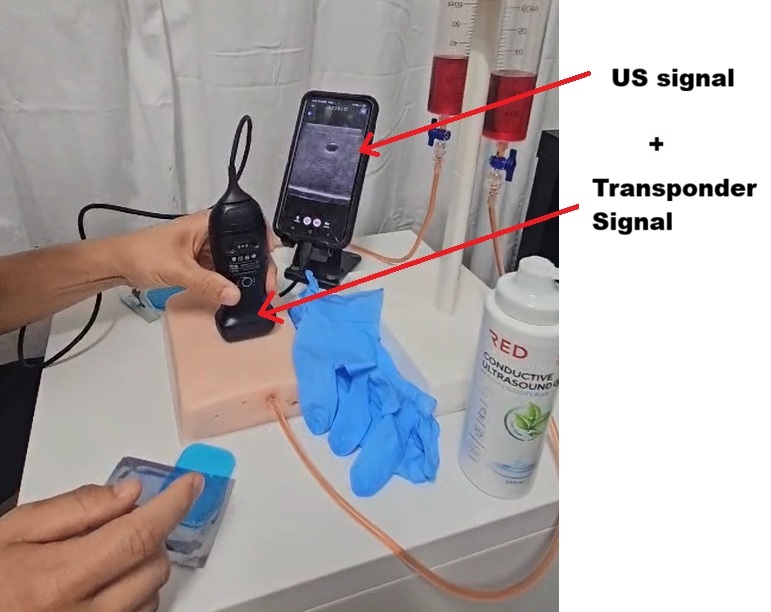
A visible ultrasound image was successfully observed on the screen while the signal passed through the full multilayer interface.
The photographic sequence documents three key conditions:
- Baseline signal confirmation with transmission path established and screen visualization present.
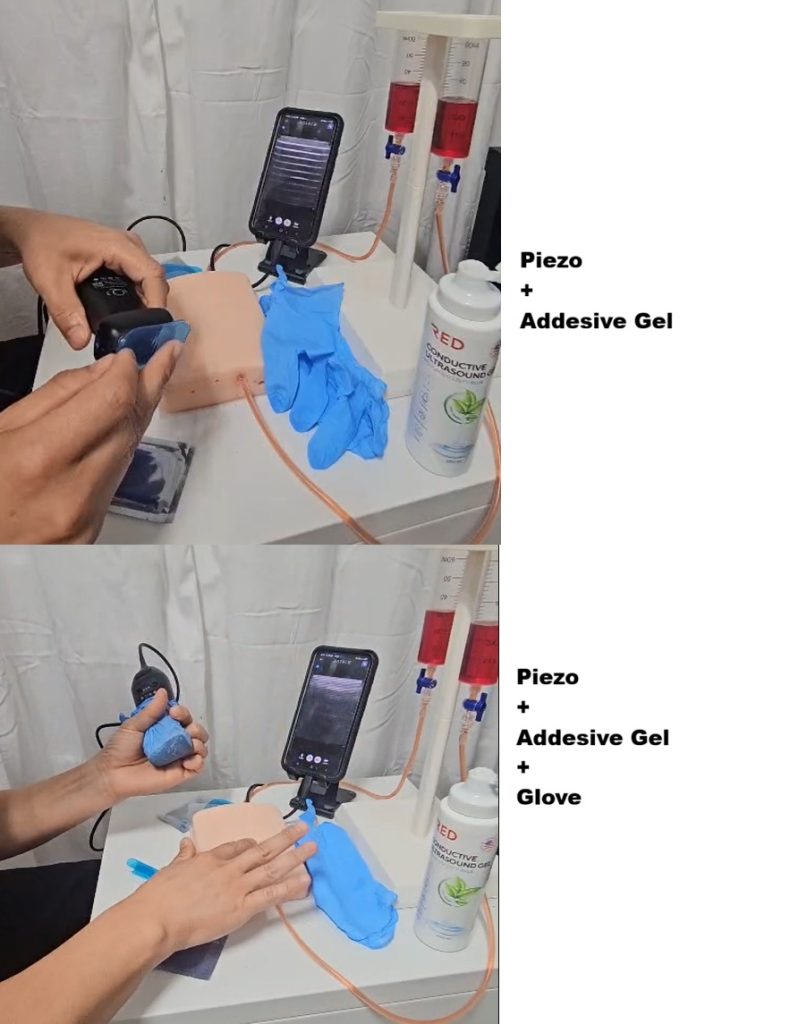
- Adhesive gel interface application demonstrating coupling between the probe-facing element and external interface material.
- Full glove-barrier transmission condition showing maintained image visualization despite the added latex glove layer.
These observations support the feasibility of signal passage through the following stacked layers:
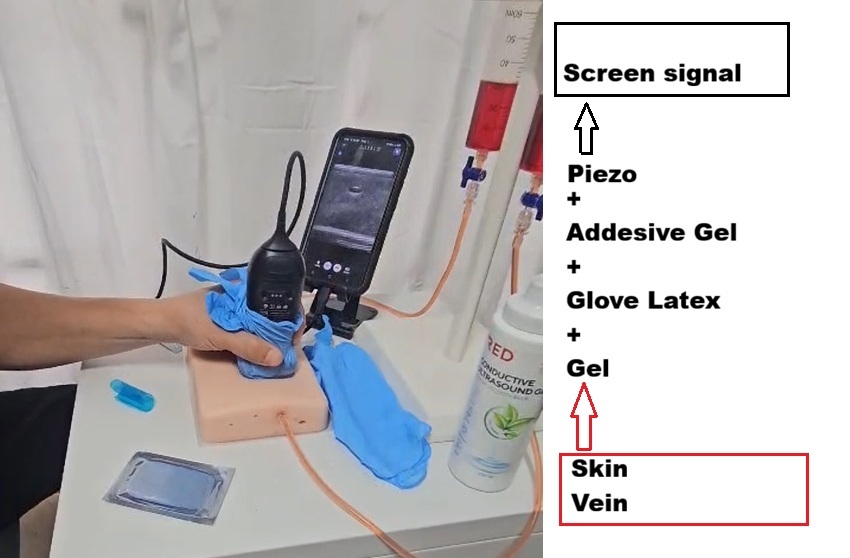
skin model → ultrasound gel → glove latex → adhesive gel → probe-facing element → functional ultrasound hardware → display
Documentation
Three representative images are being published as part of this report.
In addition, the full experiment was recorded in an uninterrupted 2-minute, 29-second video, which remains archived in the internal files of MYaccess Technology as supporting technical documentation.
Key Preliminary Finding
This experiment provides proof-of-concept evidence that an adhesive gel interface may solve the problem of ultrasound signal transmission under a glove barrier.
The test does not validate the final MYaccess gel design, but it does support the engineering premise that a properly designed adhesive coupling layer could enable wearable ultrasound operation under standard glove conditions.
Conclusion
Preliminary observations suggest that ultrasound signal transmission under a medical glove barrier is feasible when an adhesive gel interface is incorporated into the coupling pathway.
These findings support continued development of a dedicated MYaccess gel system with improved viscosity, geometry, adhesion, and clinical practicality. Most importantly, the experiment demonstrates that the glove barrier is not an absolute obstacle to signal transmission when an appropriate coupling interface is used.
Further testing should evaluate signal quality, consistency, attenuation, repeatability, ergonomics, and performance under more realistic workflow conditions.
Figure captions
Figure 1. Confirmation of functional ultrasound signal visualization during early transmission setup, supporting feasibility of signal detection through the experimental interface.
Figure 2. Intermediate setup demonstrating adhesive gel application as a coupling interface, followed by glove-layer incorporation into the transmission pathway.
Figure 3. Full multilayer proof-of-concept condition showing maintained screen visualization with the following interface: synthetic skin model, ultrasound gel, glove latex, adhesive gel, and functional ultrasound probe system.
Documentation note
Images shown here represent selected frames from the experiment.
Additional continuous video documentation of the test is maintained in MYaccess internal records.