Why One of the Most Common Procedures in Modern Medicine Still Relies on an Ancient Technique
Written by Martrin Gutierrez, RN, BSN, SRNA, DNAP (student)
In an era defined by artificial intelligence, robotic surgery, and real-time imaging, one of the most common invasive procedures in medicine still begins the same way it did in ancient civilizations:
By feeling for a vein.
Peripheral venous access is performed hundreds of millions of times each year in the United States alone—and more than a billion times globally. It is foundational to emergency care, surgery, inpatient medicine, EMS, and laboratory practice.
Yet in most cases, the first step remains unchanged:
Look.
Palpate.
Puncture.
This is the 3,500-year paradox of vascular access.
An Ancient Beginning
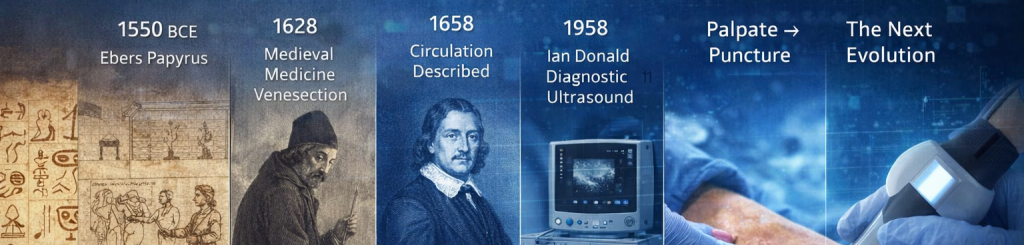
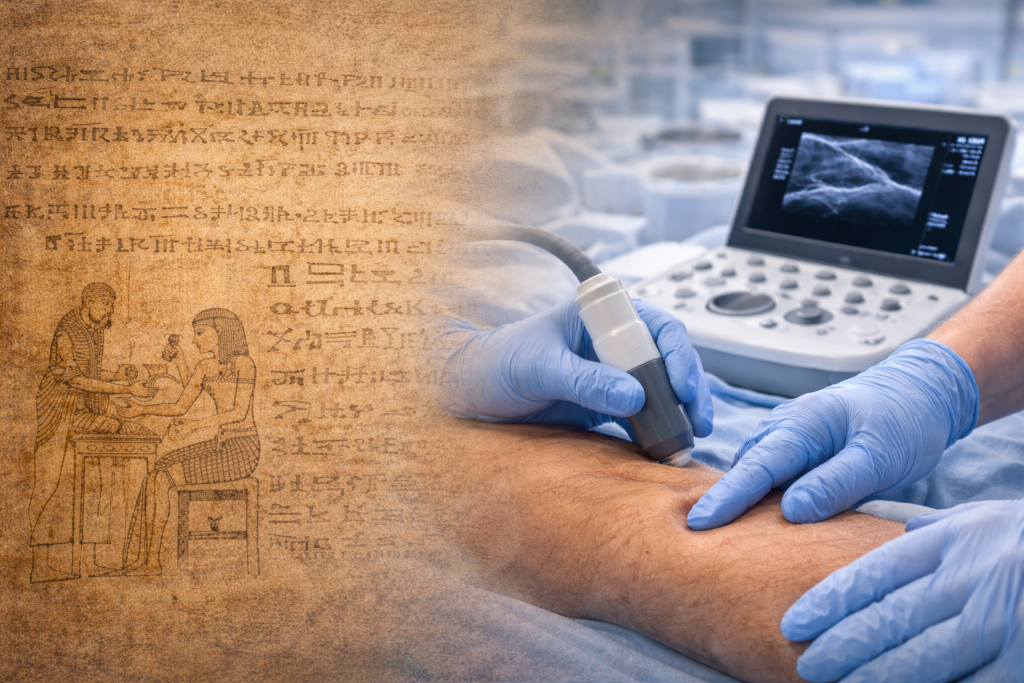
As early as 1550 BCE, the Ebers Papyrus described vascular structures known as metu. These early healers located vessels through tactile assessment—using their hands to feel beneath the skin.
Centuries later, Greek and Roman physicians refined venesection as a therapeutic tool. Medieval barber surgeons continued the practice for nearly a thousand years.
The understanding of anatomy evolved.
The science evolved.
The tools did not.
When William Harvey described circulation in 1628, the conceptual revolution did not change the mechanical act of vein selection.
During the 19th-century cholera epidemics, when modern intravenous therapy was born, physicians infused saline directly into collapsing patients to save lives.
But the vein was still chosen the same way:
Palpate → puncture.
Modern Medicine, Ancient Mechanics
The 20th century brought Teflon catheters, sterile technique, advanced pharmacology, and clinical ultrasound.
In 1958, Ian Donald introduced modern diagnostic ultrasound. For the first time, clinicians could visualize internal structures in real time.
And yet, more than six decades later, most peripheral IV insertions still begin without visualization.
Why?
Because the available ultrasound systems were never designed for continuous, frontline nursing workflow. They are:
- shared equipment
- often physician-dependent
- time-consuming to set up
- difficult to integrate during rapid bedside care
- impractical in tight emergency spaces
In fast-moving clinical environments, palpation persists because it is immediate and always available.
The Real Clinical Burden
Frontline nurses know what textbooks rarely emphasize:
- Veins that appear visible still fail.
- Depth between 0.5–1.5 cm is difficult to assess by touch alone.
- Repeated attempts increase pain, delay therapy, and raise stress levels.
- Difficult access during shock, obesity, edema, or hypotension adds cognitive and physical strain.
The National Institute for Occupational Safety and Health defines workload as the combined physical and cognitive demands placed on workers during task execution.
Venipuncture based solely on palpation amplifies both.
It forces anatomical uncertainty in moments where precision matters most.
The Hidden Safety Problem
In real practice, some clinicians tear the fingertip of their sterile glove to improve tactile sensitivity.
This compromises sterility.
Suboptimal site selection increases:
- patient discomfort
- infiltration and extravasation
- therapeutic delay
- repeated needle insertions
The irony is profound:
One of the most repeated invasive procedures in modern healthcare still relies primarily on subjective sensation.
The Paradox
Medicine has modernized nearly everything:
We image organs in real time.
We monitor hemodynamics continuously.
We analyze labs instantly.
Yet the first step of vascular access—the moment that determines success or failure—remains rooted in a technique developed over three millennia ago.
The issue is not tradition.
The issue is stagnation.
Looking Forward
The future of vascular access does not require abandoning clinical skill.
It requires aligning technology with the realities of frontline nursing:
- hands-free operation
- immediate availability
- integration into movement
- designed for superficial veins
- built for emergency pace
For 3,500 years, the clinician’s hand has guided the needle.
The next evolution will not replace that hand.
It will extend it.
Written by Martrin Gutierrez, RN, BSN, SRNA, DNAP (student)