MYaccess Research Observation Series
Electromechanical Signal Validation – Controlled Experimental Study
Part of ongoing system development and iterative testing

Study Description
This experimental evaluation focused on validating the ability of a compact piezoelectric element to generate and transmit measurable electrical signals under controlled mechanical stimulation.
The purpose of this study was not to develop a complete ultrasound imaging system, but to confirm the fundamental electromechanical response required for future signal acquisition and processing.
A simplified benchtop setup was used to isolate the interaction between mechanical input and electrical output, allowing for direct observation of signal behavior under controlled conditions.
Research Question
Can a compact piezoelectric element generate a measurable and reproducible electrical signal when subjected to controlled mechanical stimulation?
Under what conditions can signal behavior be clearly distinguished from background noise within a simplified experimental environment?
Controlled Experimental Setup
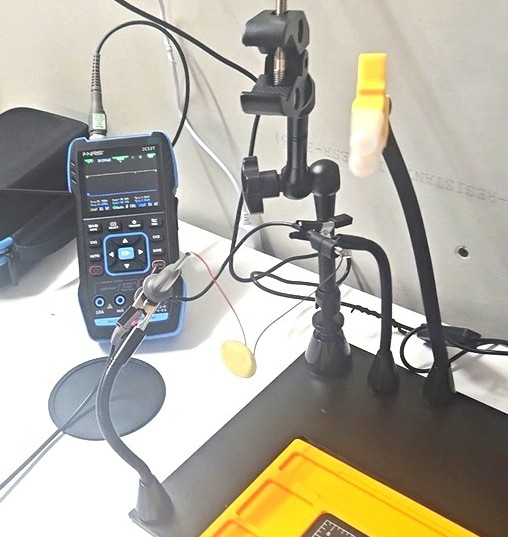
A simplified benchtop experimental environment was established to isolate and evaluate piezoelectric signal generation under controlled conditions.
The setup included direct electrical connections between the piezoelectric element and a portable oscilloscope, minimizing intermediary components and reducing potential sources of signal distortion.
Mechanical stimulation was applied both manually and through controlled piezo-to-piezo interaction, allowing comparison between variable and structured input conditions.
The configuration was specifically designed to ensure that observed signals could be attributed to controlled stimulus input rather than environmental interference.
Signal Behavior Observations
Under controlled experimental conditions, measurable electrical signals were consistently observed in direct correlation with applied mechanical stimulation of the piezoelectric element.
Signal presence was dependent on active stimulation, with a stable baseline observed in the absence of input. Variations in signal amplitude and waveform characteristics were directly associated with differences in stimulation intensity and method.
Controlled piezo-to-piezo interaction produced more consistent and structured signal patterns compared to manual stimulation, indicating improved repeatability under defined input conditions.
These observations support the ability to generate and detect stimulus-driven signals while maintaining a clear distinction from background noise within the experimental setup.
The experimental configuration was designed to isolate signal generation and ensure that observed electrical responses were directly attributable to controlled mechanical stimulation.
Direct coupling between the piezoelectric element and the measurement system allowed real-time signal acquisition while minimizing external interference.
This setup enabled consistent observation of stimulus-driven signal behavior under stable and reproducible conditions.
The configuration also enabled clear differentiation between stimulus-driven signal responses and baseline noise, reinforcing the reliability of the measurement approach. Consistent signal detection across repeated trials further supports the stability of the experimental setup.
This level of control is critical in early-stage system development, where isolating fundamental signal behavior is necessary before advancing to more complex architectures involving signal processing, imaging reconstruction, and integration into wearable formats.
Relevance to System Development
These findings represent an early validation of the fundamental electromechanical behavior required for the development of a wearable ultrasound-assisted vascular access system.
The ability to generate, detect, and distinguish stimulus-driven signals under controlled conditions supports the feasibility of building a compact, integrated sensing system aligned with the MYaccess™ concept.
This experimental phase establishes a foundation for subsequent development steps, including signal conditioning, pulse generation, and interpretation of reflected signals within clinically relevant environments.
While not yet representing imaging capability, this validation confirms that the underlying physical mechanism required for ultrasound-based interaction is present and measurable.
Limitations
This study was conducted under simplified laboratory conditions and does not represent full system integration or clinical application.
Further development is required to evaluate signal behavior across biological tissue interfaces, coupling materials, and dynamic clinical environments.