What international guidelines say — and what we observe in real clinical practice
Written by Martrin Gutierrez, RN, BSN, SRNA, DNAP (student)
Every year, hundreds of millions of peripheral intravenous (IV) access procedures are performed in hospitals around the world. It is one of the most common procedures in modern medicine, yet it still relies heavily on a manual technique: palpating a vein beneath the skin.
International guidelines acknowledge this reality.
Reference documents from the World Health Organization (WHO) describe peripheral intravenous catheter insertion as a procedure primarily performed at the patient’s bedside and highly dependent on the clinician’s skill. These same guidelines also recognize frequent challenges associated with the procedure, including difficulty locating veins, multiple insertion attempts, and complications related to vascular access.
In other words, even from a global institutional perspective, vascular access remains a procedure strongly dependent on the operator’s individual experience.
But what does this look like in everyday clinical practice?
During the early development of our project, we conducted a series of ergonomic evaluations with active healthcare professionals. In total, more than thirty clinicians voluntarily participated in these preliminary observations.
The findings were not surprising to those who work on the clinical frontline.
Many participants described a sense of uncertainty when attempting to locate veins using palpation alone, particularly in difficult patients. In several cases, users spontaneously commented that they would prefer to visualize the vein before inserting the catheter.
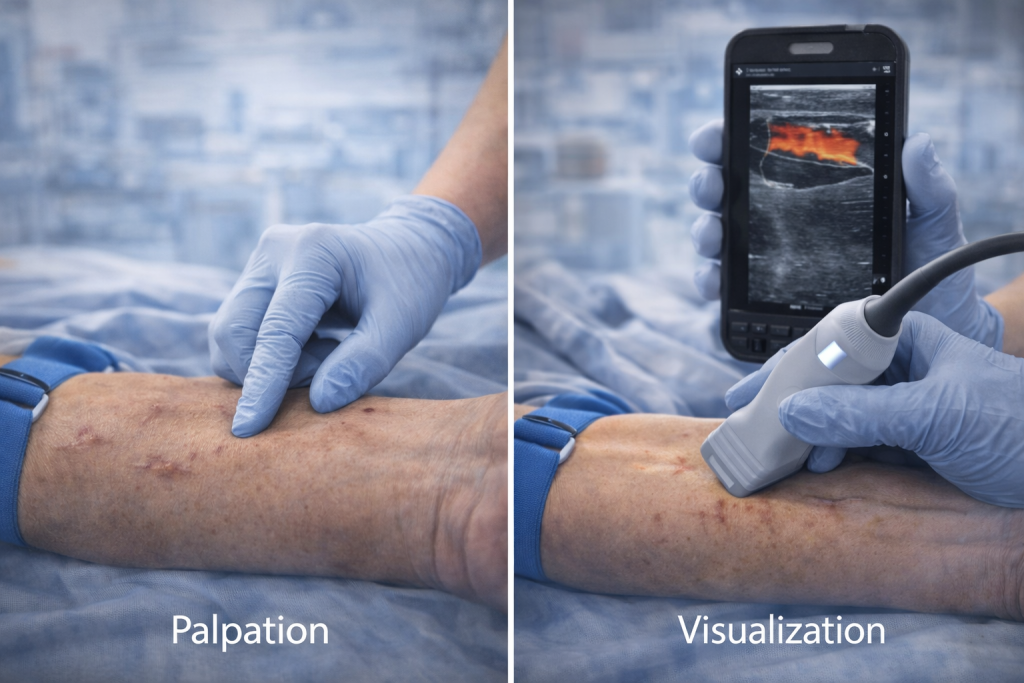
These observations do not represent a formal clinical study, but they reflect something important: the accumulated experience of professionals who perform this procedure every day.
And that experience consistently points to the same challenge.
In theory, vascular access is a simple procedure. In practice, it can quickly become difficult when patients present with challenging veins, dehydration, obesity, edema, or a history of repeated hospitalizations.
Each failed attempt does more than delay treatment. It also increases patient discomfort, clinician frustration, and the time required to complete a procedure that should ideally take only minutes.
When we place international guidelines alongside real clinical experience, a clear conclusion begins to emerge.
Modern medicine has advanced enormously in diagnostics, monitoring, and treatment. Yet one of its most common procedures still depends largely on the tactile skill of the operator.
For thousands of years, medicine has searched for veins with the fingers.
Today, we are beginning to ask whether it is time to search for them with something more.
Written by Martrin Gutierrez, RN, BSN, SRNA, DNAP (student)