The Nurse of the Future: The Future Is Now
Observations from the Frontline of Clinical Care
Written by Martrin Gutierrez, RN, BSN, SRNA, DNAP (student)
And Yisel Menendez RN, BSN, SRNA, DNAP (student)
For decades, nursing has supported the healthcare system from the frontline. Yet a clear paradox remains: while medicine and technology continue to advance, many of the tools used in daily nursing practice are still not designed from the perspective of the clinician working directly at the bedside.
In emergency departments, critical care units, and acute hospital environments, nurses operate in settings where seconds matter. Vascular access, patient monitoring, medication administration, documentation, and clinical assessment often occur simultaneously under high-pressure conditions.
Despite this reality, technological innovation in healthcare has rarely started from the perspective of those who spend the most time with the patient.
That narrative is beginning to change.
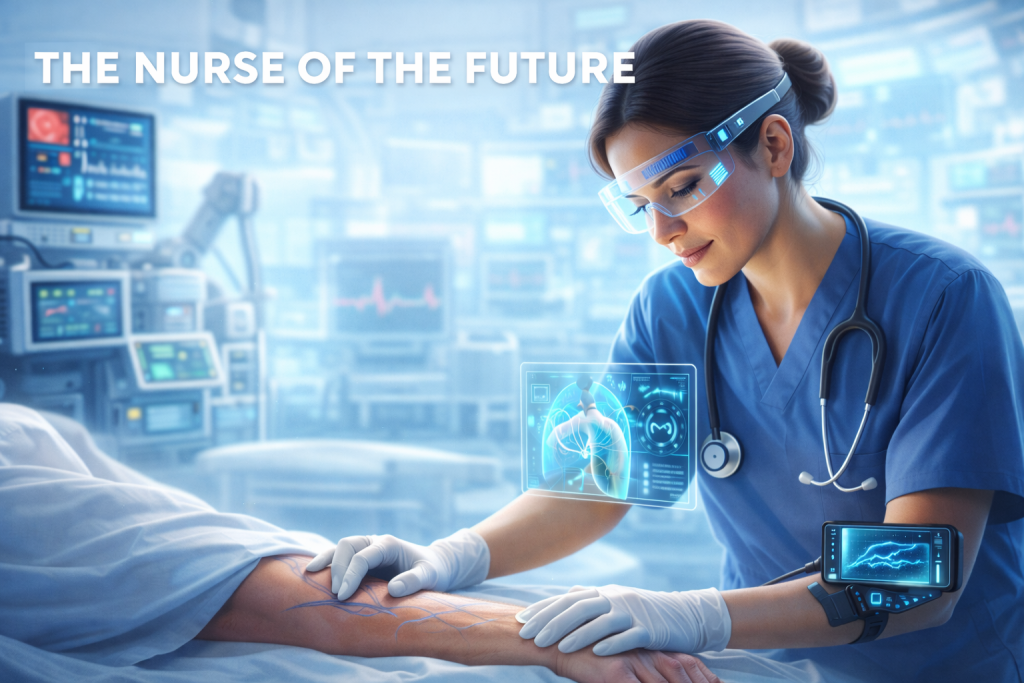
The Nurse of the Future
The nurse of the future can no longer be viewed simply as a procedural executor within a rigid system. Increasingly, modern nurses are defined by their ability to make rapid decisions, manage complex situations, and coordinate interventions in real time.
In practice, this means the nurse becomes:
• An autonomous clinical operator within their professional scope
• A manager of chaos in emergency and trauma environments
• A technical professional capable of integrating new tools into clinical care
• An operational leader in situations where patient stability can change in seconds
This evolving role requires something equally important: technology designed for real clinical workflow.
Vascular Access in Frontline Practice
Peripheral intravenous access remains one of the most commonly performed procedures in modern medicine. Yet in real clinical practice, obtaining venous access can quickly become challenging.
Patients with obesity, dehydration, chronic illness, or repeated hospitalizations frequently present difficult vascular access. In emergency settings, where time and space are limited, these challenges become even more pronounced.
Historically, the response to this problem has been to rely on operator experience — the nurse who “never misses a vein.”
But reliance on individual expertise alone is not a structural solution.
True innovation occurs when technology integrates naturally into the clinician’s workflow.
MYaccess™: Innovation Emerging from Clinical Practice
MYaccess™ emerges as an initiative focused on observing, studying, and modeling solutions to the real challenges clinicians face during vascular access procedures.
Rather than focusing solely on building another medical device, the goal is to understand how procedures actually occur in clinical environments and explore solutions that integrate realistically into that workflow.
From these observations, a central idea begins to emerge:
The next innovation in frontline vascular access will likely not come from a larger machine or a device with more functions placed next to the nurse, but from technology that functions as a direct extension of the clinician performing the procedure.
A tool that amplifies human capability rather than competing with it.
Conclusion
The evolution of nursing will not depend solely on new devices, but on how clinical tools are designed and integrated into real practice.
Listening to frontline clinicians helps reveal opportunities to improve procedures performed millions of times every day.
The nurse of the future will not be defined only by the technology they use, but by how that technology integrates intelligently into their clinical practice.
That future is already beginning to take shape.
Written by Martrin Gutierrez, RN, BSN, SRNA, DNAP (student)
And Yisel Menendez RN, BSN, SRNA, DNAP (student