MYaccess Research Observation Series
Experiment ID: EXP-024

Study Description
This experimental evaluation focused on validating acoustic transmission and reception behavior using paired piezoelectric transducers under PWM-controlled excitation conditions.
The purpose of this study was not to develop a complete ultrasound imaging system, but rather to evaluate whether controlled acoustic energy generated at a transmitting piezoelectric element could be detected through a simplified receiving configuration under benchtop laboratory conditions.
A TX/RX platform was assembled to evaluate:
- Piezoelectric acoustic signal transmission
- Signal reception and waveform acquisition
- Mechanical coupling behavior
- Oscillatory response characteristics
- Baseline acoustic propagation feasibility
This experiment represents part of an ongoing iterative engineering validation process associated with wearable ultrasound-oriented system development within the MYaccess™ research platform.
Research Question
Can acoustic energy generated through PWM-controlled excitation of a transmitting piezoelectric element be detected through a paired receiving transducer under simplified benchtop conditions?
Secondary questions included:
Does the experimental platform support preliminary feasibility of acoustic signal propagation relevant to wearable ultrasound-oriented architectures?
Can transmitted waveform behavior be reproducibly detected?
Does acoustic coupling influence signal acquisition?
Can TX/RX interaction produce measurable oscillatory responses?
Objective
To establish and validate a simplified TX/RX piezoelectric platform capable of generating, transmitting, and detecting acoustic-driven signal behavior under PWM-controlled excitation conditions.
Additional objectives included:
Supporting early-stage engineering feasibility assessment for wearable ultrasound-oriented architectures
Evaluating baseline acoustic signal propagation
Observing waveform reception characteristics
Assessing coupling-dependent signal behavior
Establishing repeatable TX/RX acquisition conditions
Experimental Hardware Configuration
- PWM signal generator
- DC power source
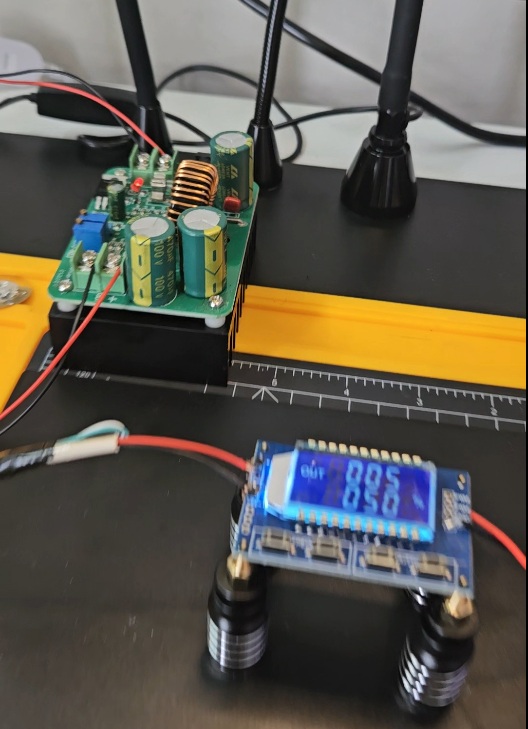
- Power driver stage
- Piezoelectric transmitting element (TX)
- Piezoelectric receiving/acquisition configuration (RX)
- Portable digital oscilloscope (FNIRSI)
- Mechanical stabilization structures
- Direct coupling and open-air experimental conditions
- Wiring, connectors, and benchtop support platform
Controlled Experimental Setup
A benchtop TX/RX acoustic transmission platform was assembled to evaluate piezoelectric signal propagation under PWM-controlled excitation conditions.
The transmitting transducer (TX) was energized using a PWM-controlled excitation pathway consisting of a DC power stage and adjustable frequency/duty-cycle modulation.
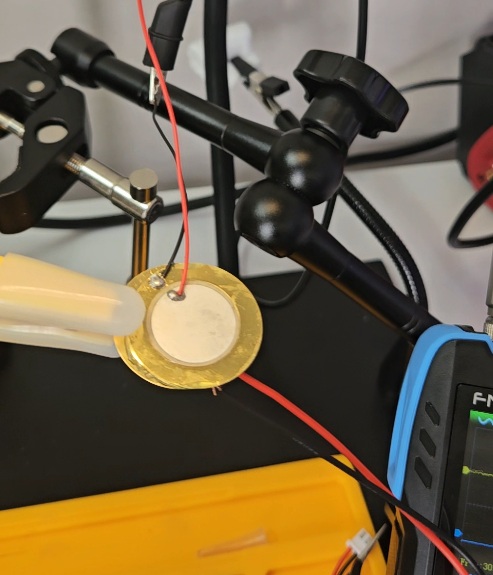
A receiving transducer (RX) was positioned under controlled coupling conditions using acoustic gel to minimize transmission losses associated with air interfaces.
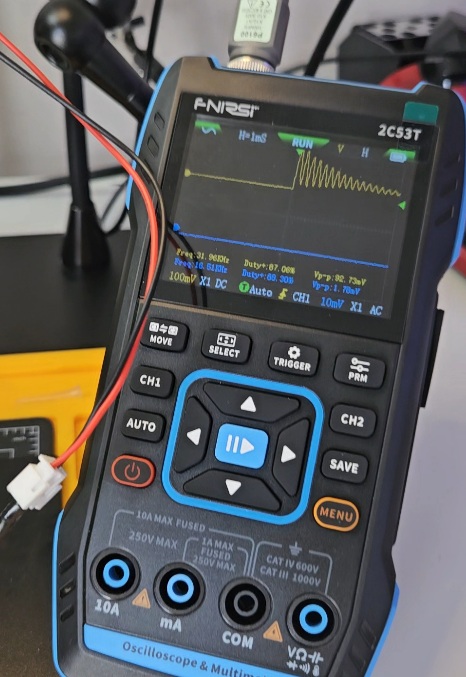
The RX pathway was connected directly to oscilloscope acquisition to observe waveform reception behavior in real time.
The experimental setup allowed controlled variation of:
- Frequency
- Duty cycle
- Mechanical coupling pressure
- Transducer alignment
- Contact stability
Mechanical stabilization structures were used to improve repeatability and reduce uncontrolled positional variability during waveform acquisition.
The configuration was intentionally designed to isolate baseline acoustic transmission behavior prior to advanced signal conditioning, AFE integration, and MHz-range transducer experimentation.
Acoustic Transmission Observations
Under controlled excitation conditions, measurable waveform activity was consistently observed in the receiving transducer following acoustic transmission from the transmitting piezoelectric element.
Observed responses demonstrated:
- Detectable TX/RX acoustic signal transfer
- Repeatable waveform acquisition
- Oscillatory transient response behavior
- Coupling-dependent signal amplitude variation
- Sensitivity to excitation frequency and duty cycle
The received waveform behavior was consistent with expected piezoelectric transmission and reception dynamics under controlled benchtop conditions.
Signal acquisition quality was strongly influenced by:
- Mechanical alignment
- Coupling pressure
- Presence of acoustic gel
- Transducer positioning stability
- Excitation parameter configuration
The use of acoustic coupling gel significantly improved transmission consistency and reduced losses associated with air interfaces.
Observed oscillatory waveform responses support the physical feasibility of acoustic energy propagation between paired piezoelectric transducers within a simplified TX/RX configuration.
Experimental Interpretation
The observed TX/RX responses are consistent with expected electromechanical and acoustic transmission behavior associated with piezoelectric systems.
Within the experimental configuration:
- Electrical PWM excitation generated mechanical vibration at the transmitting transducer
- Acoustic energy propagated through the coupling interface
- Mechanical energy was subsequently converted back into measurable electrical activity at the receiving transducer
The waveform behavior observed in the receiving pathway supports the feasibility of controlled acoustic energy transfer between paired piezoelectric elements under simplified benchtop conditions.
The dependence of signal amplitude and waveform quality on coupling conditions further supports the importance of acoustic interface optimization for future wearable ultrasound-oriented architectures.
Although the current platform operates within an early-stage laboratory environment and outside clinical ultrasound frequency ranges, the experiment establishes foundational evidence supporting acoustic transmission feasibility.
Key Preliminary Finding
This experiment demonstrated that acoustic energy generated through PWM-controlled excitation of a transmitting piezoelectric element can be detected through a paired receiving transducer under controlled benchtop conditions.
Observed waveform behavior supports the feasibility of acoustic signal propagation, reception, and acquisition within a simplified TX/RX piezoelectric platform.
The experiment additionally demonstrated that coupling quality, alignment stability, and excitation parameters directly influence waveform acquisition characteristics and received signal consistency.
Conclusion
This preliminary TX/RX benchtop experiment demonstrated measurable acoustic transmission and reception behavior between paired piezoelectric transducers under PWM-controlled excitation conditions.
The observed waveform responses support the physical feasibility of acoustic energy propagation and reception within a simplified piezoelectric transmission platform relevant to future wearable ultrasound-oriented architectures.
These findings establish foundational evidence supporting continued development of:
- TX/RX acoustic pathways
- Coupling optimization
- Signal conditioning
- AFE integration
- MHz-range transducer experimentation
- Wearable distributed transducer systems
Future experimental phases may include quantitative attenuation characterization, biological interface simulation, time-of-flight analysis, and advanced waveform processing.
Figure captions
Figure 1. PWM-controlled TX excitation platform incorporating DC power modulation hardware and transmitting piezoelectric stimulation circuitry used for controlled acoustic signal generation experiments.
Figure 2. TX/RX acoustic coupling setup showing paired piezoelectric transducers positioned under controlled benchtop transmission conditions.
Figure 3. Oscilloscope waveform acquisition demonstrating measurable received signal behavior following acoustic transmission between TX and RX transducers.
Documentation Note
Images shown in this report represent selected frames from the experimental sequence.
Additional continuous video documentation of the TX/RX transmission experiment is maintained within MYaccess™ internal technical records.
Documentation note
Images shown here represent selected frames from the experiment.
Additional continuous video documentation of the test is maintained in MYaccess internal records.